
20 Checks Every Off-The-Plan Buyer Should Make Before Signing a Contract
A Simple, Plain-English Checklist That Shows You Exactly What to Look For — So You Can Protect Your Money and Build Real Wealth
From The Desk Of
IAN MARSH
Founder, Winning Edge Real Estate
Gold Coast, Queensland
Dear Property Buyer,
Let me ask you a blunt question.
When you look at an off-the-plan apartment, how do you know whether you’re looking at a genuinely strong opportunity…
Or simply a very good brochure?
Because every brochure looks impressive.
The kitchens sparkle.
The rooftop pool looks magnificent.
And the projected numbers usually behave themselves beautifully.
But brochures are designed to sell the property.
They are not designed to show you everything that could go wrong.
That’s why I created this guide.
It contains the 20 checks I use before recommending an apartment to a client—or considering buying one myself.
And, in the interest of being completely transparent, I’m a licensed real estate agent who specialises in identifying what I believe are off market apartments and developments that are likely to outperform the market and produce higher potential gains.
So yes, I have a commercial interest in this market.
But I certainly don’t believe every new apartment is a good investment.
Far from it.
A property still has to earn the right to be recommended.
I bought my first property at 19 and went on to build a multi-million-dollar property portfolio. I’ve also used the same basic principle—research first, emotion second—to build five multi-million-dollar companies.
This guide will help you look beyond the glossy pictures and ask better questions about:
- The location and its long-term demand
- The developer and builder
- The apartment’s layout, views and resale appeal
- Rental income, strata fees and real holding costs
- The risks that could affect your settlement or future value
You may decide to buy.
You may decide to walk away.
Either could be the right decision.
The goal is simply to make that decision with your eyes open…
Rather than your fingers crossed.
Let’s get into it.
Ian Marsh
Property investor, licensed real estate agent and founder of Winning Edge Real Estate
How To Use This Guide
Keep the development brochure, price list and floor plan open as you go through the 20 checks.
For each check, mark the property:
- Green: Strong evidence
- Investigate: More information required
- Red flag: Serious concern
A good-looking apartment can still be a poor investment. The purpose of this guide is to separate the two.
That immediately turns the guide from an article into a tool.
Your Result
16–20 green checks: Worth investigating further
11–15 green checks: Important questions remain
10 or fewer green checks: Do not proceed without substantial additional investigation
The Exact Checklist I Use Before Recommending Any Development
1. Growth Potential
What to check
Review the suburb’s average apartment growth over approximately ten years—not simply its latest twelve-month result.
Why it matters
One strong year may be an aberration. A longer history gives you a better indication of whether demand has been reasonably consistent through different market conditions.
As an internal benchmark, Ian generally prefers to see approximately 6–7% average annual growth or better where possible. However, this is only one indicator and does not guarantee future growth.
Warning sign
The sales presentation highlights one recent boom year but avoids discussing the longer-term results.
Where to check
CoreLogic, PropTrack, Domain, Australian Property Monitors or another independent property-data provider.
Research Tool: CoreLogic Property Market Reports
What to check
Compare current buyer and tenant demand with the existing apartment supply and the number of new apartments planned for the area.
Why it matters
Strong demand combined with limited suitable supply may support rents and resale values. Too much competing stock may make an apartment harder to rent or sell.
Do not look only at the suburb-wide number. Consider how much competing stock is genuinely comparable in size, quality, location and price.
Warning sign
Several similar developments are due to complete at approximately the same time.
Where to check
SQM Research, council development applications, current listings, planning documents and local property managers.
Research Tool: SQM Research – Property Data
What to check
Understand who currently lives in the area and who is likely to move there in the future.
Look at:
- Age groups
- Household incomes
- Family sizes
- Employment
- Owner-occupier numbers
- Population growth
Why it matters
The apartment must suit the people most likely to rent or buy it.
Young professionals may value transport, restaurants and work access.
Downsizers may prefer larger floor plans, storage, security and nearby medical facilities.
Families may need multiple bedrooms, parking, schools and parks.
The property should match the market—not simply look good in the brochure.
Warning sign
The apartment has been designed for a buyer or tenant group that is not strongly represented in the area.
Where to check
Australian Bureau of Statistics community profiles, council population forecasts and local property managers.
Research Tool: ABS Community Profiles
What to check
Look for genuine evidence that an area is improving.
This may include:
- New transport
- Parks and public spaces
- Retail and dining precincts
- Hospitals and universities
- Employment projects
- Foreshore improvements
- Private and government investment
Why it matters
Buying before major improvements are completed may allow you to benefit as the area becomes more desirable.
But planned infrastructure should only be one part of the decision.
A press release, election promise or proposed project does not guarantee that work will happen on schedule—or at all.
Warning sign
The entire investment case depends on vague future plans with no funding, approval or confirmed delivery date.
Where to check
Government budgets, official infrastructure plans, council documents and approved development applications.
Research Tool: Infrastructure Australia Priority List
What to check
Investigate what may be built around the property.
Future development could bring better transport, shopping, entertainment and employment.
It could also bring more traffic, noise, competing apartments or a large building directly in front of your view.
Why it matters
Not all new development is positive.
A new restaurant precinct may improve the location.
Ten new apartment towers completing together may create significant competition for tenants and future buyers.
You need to understand both sides before buying.
Warning sign
The marketing highlights all the future amenities but says nothing about the amount of competing apartment supply being approved nearby.
Where to check
Council planning portals, zoning maps, development applications and state government planning information.
Research Tool: Local Council Development Applications
What to check
Review the strength and diversity of the local economy.
Consider:
- Employment growth
- Household incomes
- Major employers
- New business investment
- Infrastructure spending
- The range of industries supporting the area
Why it matters
People generally move to areas where they can find work and afford the lifestyle.
A strong and varied employment market may support population growth, rental demand and future property demand.
An area that depends heavily on one employer or industry may carry more risk if conditions change.
Warning sign
Most local employment relies on one company, project or struggling industry.
Where to check
Australian Bureau of Statistics data, government economic reports, council plans and major employment announcements.
Research Tool: RBA Economic Indicators
What to check
Ask one simple question:
“If I had to sell this apartment in five or ten years, why would someone choose it over the alternatives?”
Look for features such as:
- A functional floor plan
- Natural light
- Privacy
- Storage
- Parking
- Usable outdoor space
- A good outlook
- Walkability
- A desirable position within the building
Why it matters
You are not only buying for today.
At some point, another buyer may need to want the apartment enough to pay a strong price for it.
Warning sign
The only clear reason to buy the apartment is that it is cheaper than the others.
Cheap is not always value.
Sometimes it is the market quietly telling you something.
Where to check
Comparable settled sales, current resale listings and completed buildings in the surrounding area.
Research Tool: Domain Suburb Trends
2. Developer & Construction Risks
What to check
Investigate the developer’s experience, financial standing and history of completing similar projects.
Where possible, inspect developments they finished several years ago—not only their latest display suite.
Why it matters
A development may look impressive on paper, but the developer still needs the experience and financial capability to deliver it.
A strong track record does not remove every risk.
However, it gives you more evidence than a glossy render and a confident salesperson.
Warning sign
The developer has little relevant experience, no comparable completed buildings or a complicated history involving failed projects and changing company entities.
Where to check
ASIC company records, previous developments, insolvency notices, buyer feedback and independent legal searches.
Research Tool: Master Builders Australia
What to check
Confirm who is actually building the project.
Review the builder’s:
- Licence history
- Financial position
- Completed buildings
- Relevant experience
- Defect history
- Record of completing projects
Why it matters
The developer sells the vision.
The builder has to turn it into a real building that does not leak, crack or begin falling apart before the removalists arrive.
Quality construction may reduce defects, disputes and expensive future repairs.
Warning sign
The builder has not been appointed, regularly changes or has a history of serious defects, licence problems or unfinished projects.
Where to check
The relevant state building regulator, completed developments, industry records and independent building professionals.
Research Tool: Product Review – Builder Ratings
What to check
Find out whether the project has:
- Development approval
- A confirmed builder
- Construction funding
- A realistic commencement date
- A realistic completion timeframe
- Any sales or finance conditions that must be met first
Why it matters
A launch date is not the same as a construction start date.
Delays may affect your moving plans, expected rental income, borrowing capacity and ability to purchase another property.
Off-the-plan construction nearly always involves some uncertainty, so the question is whether the proposed timeline appears properly supported.
Warning sign
Completion dates keep moving, construction has not started, the builder is unconfirmed or no one can clearly explain what must happen before work begins.
Where to check
The contract, council approvals, developer updates, the builder and your solicitor.
Research Tool: UDIA Insights
What to check
Look beyond the total number of square metres.
Review:
- Room dimensions
- Natural light
- Ventilation
- Furniture placement
- Storage
- Privacy
- Balcony usability
- Kitchen layout
- Bedroom separation
- Wasted hallway space
- Quality of finishes
Why it matters
A well-designed apartment may feel larger and work better than a bigger apartment with a poor layout.
Good design may also appeal to a broader range of tenants and future buyers.
Do not be distracted by expensive-looking tapware while ignoring a bedroom that barely fits a bed.
Warning sign
The furniture shown on the plan appears unusually small, rooms have awkward shapes or a large part of the advertised area is unusable.
Where to check
Scaled floor plans, detailed dimensions, display apartments, architectural drawings and a furniture-placement plan.
What to check
Investigate whether the building or surrounding area may be affected by:
- Flooding
- Bushfire
- Coastal erosion
- Landslip
- Severe weather
- Road or aircraft noise
- Contaminated land
- High insurance costs
Why it matters
The apartment itself may sit above the flood level while the basement, access roads, lifts or building services remain exposed.
Environmental risks can affect insurance, maintenance costs, tenant demand and future resale appeal.
Warning sign
The risk is dismissed without evidence, or it is difficult to obtain suitable insurance at a reasonable cost.
Where to check
Council hazard maps, state government mapping, environmental searches, insurance providers and your solicitor.
Research Tool: National Flood Information Database
3. Your Cashflow & Real Costs
What to check
Obtain at least two independent rental appraisals.
Calculate both:
Gross yield: Annual rent before expenses.
Net yield: The income remaining after ongoing property expenses.
Include realistic allowances for:
- Strata
- Rates
- Insurance
- Management fees
- Maintenance
- Vacancy
- Letting costs
Why it matters
The advertised weekly rent is not the amount you keep.
A property may appear to offer a strong return until the real ownership costs are included.
Warning sign
The rental projection comes only from the developer or sales agent and is noticeably higher than comparable properties.
Where to check
Independent local property managers, current rental listings and comparable completed apartments.
Research Tool: Realestate.com.au Rental Data
What to check
Review the proposed body corporate budget and estimate the complete cost of owning the apartment.
Consider:
- Strata fees
- Council rates
- Water
- Insurance
- Property management
- Maintenance
- Land tax where applicable
- Short-stay or letting fees
- Future capital works
Why it matters
Facilities cost money to operate.
Pools, lifts, gyms, gardens, concierge services and large common areas all require maintenance.
A very low initial strata estimate may look attractive, but it needs to be realistic for the building being proposed.
Warning sign
The projected strata fees seem unusually low for the building’s size, facilities and level of service.
Where to check
The proposed body corporate budget, disclosure documents, comparable completed buildings and your accountant or solicitor.
What to check
Speak with a qualified accountant about how the property could affect your individual tax position.
Possible considerations may include:
- Building depreciation
- Plant and equipment deductions
- Interest expenses
- Negative gearing
- Land tax
- Capital gains tax
Why it matters
Tax deductions may reduce some of the cost of holding an investment property.
However, tax benefits should never turn a poor property into a good investment.
Losing one dollar to recover part of it through tax is not a clever wealth strategy.
Warning sign
The investment only appears affordable or attractive because of estimated tax deductions.
Where to check
A qualified accountant, registered tax agent and depreciation specialist.
Research Tool: BMT Tax Depreciation
What to check
Review the current vacancy rate and how it has changed over time.
Also consider the number of similar rental apartments likely to enter the market.
Why it matters
A low vacancy rate may indicate strong tenant demand.
A high vacancy rate may mean the property takes longer to rent or requires a lower asking price.
However, suburb-wide figures do not tell the entire story.
A high-quality, well-positioned apartment may perform differently from older or poorly designed stock nearby.
Warning sign
The investment relies on uninterrupted rental income, but the location has rising vacancies or a large pipeline of competing apartments.
Where to check
SQM Research, independent property managers and current rental listings.
Research Tool: SQM Vacancy Rates
What to check
Consider how much of the development is likely to be purchased by people who intend to live there.
Also investigate the expected level of permanent rentals and short-stay accommodation.
Why it matters
Strong owner-occupier appeal may broaden the future buyer market and support longer-term care of the building.
However, the ratio alone does not guarantee quality.
The apartment still needs the right size, design, position and facilities to appeal to people who genuinely want to live there.
Warning sign
Nearly every apartment is small, identical and marketed mainly through rental projections or short-stay income.
Where to check
The apartment mix, sales information, building rules, proposed management arrangements and feedback from the selling team.
Research Tool: CoreLogic Suburb Data
4. Location & Lifestyle Factors
What to check
Investigate what can legally be built on nearby land.
Do not assume a view is protected simply because:
- The land is currently vacant
- A small building sits there today
- The render shows an uninterrupted outlook
- The salesperson says development is unlikely
Why it matters
A view may represent a significant part of the apartment’s price and future appeal.
If that view disappears, the property may lose privacy, natural light and some of the premium you originally paid.
Warning sign
You are being asked to pay a substantial view premium, but the land in front can legally be redeveloped.
Where to check
Council planning portals, zoning maps, development applications, architectural drawings and your solicitor.
Research Tool: Local Council Planning Websites
What to check
Measure the genuine walking distance to:
- Shops
- Cafes and restaurants
- Public transport
- Parks
- Medical facilities
- Schools
- Employment
- The beach or waterfront
- Everyday services
- Walk the route yourself where possible.
Why it matters
Convenience is valuable to tenants, owner-occupiers and future buyers.
But “five minutes away” can mean five minutes by car—not five minutes on foot.
A major road, steep hill or unsafe crossing can make a short distance feel much longer.
Warning sign
The brochure says the property is close to everything, but most daily trips still require a car.
Where to check
Google Maps, Walk Score, public transport maps and an on-foot inspection.
Research Tool: WalkScore
5. Market & Timing Factors
What to check
Consider whether the local apartment market appears to be:
- Recovering
- Growing
- Approaching a peak
- Slowing
- Declining
- Review price growth, listing numbers, days on market, rental demand, new supply and buyer activity.
Why it matters
Market conditions may affect the price you pay and how quickly the property grows afterwards.
However, nobody can consistently identify the exact top or bottom of a property cycle.
The goal is not to guess the perfect day to buy.
It is to avoid overpaying for the wrong property because everyone else suddenly appears excited.
Warning sign
The main reason for buying is urgency, fear of missing out or a claim that prices can only go up.
Where to check
Independent market reports, recent settled sales, listing trends, local agents and the Herron Todd White Property Clock.
Research Tool: Herron Todd White Property Clock

This checklist shows you what to look at.
But if you want me to personally walk you through how this applies to the best opportunities available right now, book a free Discovery Call below. Clarity, not pressure.
How People Are Using This Exact System to Build Real Financial Independence
Look, I’m not going to promise you’ll be rich overnight. That’s not how it works.
But I will show you a realistic path that many of my clients have followed — starting with one smart apartment and using leverage the right way.
Here’s the simple 4-step approach:
Step 1: Secure your first smart apartment (one that ticks the boxes in the checklist).
Step 2: Let time and equity do the heavy lifting while it’s being built.
Step 3: Use the growing equity to add the next property (repeat smartly).
Step 4: Optimise, keep the winners, and watch it compound.
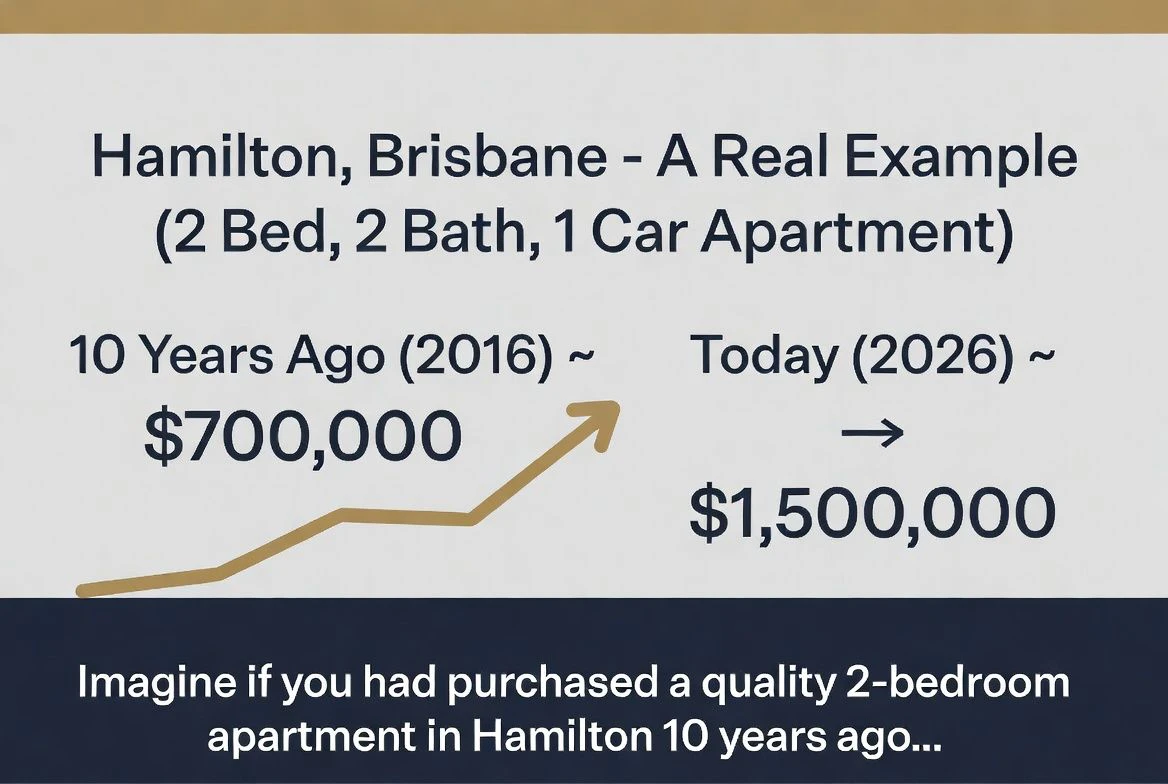
This is the kind of growth that has actually happened in one of Brisbane’s strongest inner suburbs. Imagine what that could have meant if you had purchased a quality 2-bedroom apartment in Hamilton 10 years ago.
Picture this in 8 to 10 years.
You’re not worrying about money the same way you do now. Your properties are working in the background while you’re living your life — travelling, spending time with family, or doing whatever you actually want to do.
That’s what getting this right from the start can create.


IAN MARSH, Founder & CEO
Ian invested in his first property at the age of 19. He has helped thousands of people succeed in both businesses in real estate and is an award-winning Sales and Marketing Expert, Real Estate Agent, Property Investor, and Best Selling Author.
Ian's key philosophy is to first Understand before seeking to be understood!
+61 466 427 900 | ian@winningedgerealestate.com.au
DISCLAIMER
→ Please note, that I am not a financial planner. My only qualification is that I am a licensed real estate agent, possess a multi-million dollar property portfolio, have built 5 multi-million dollar companies, and have been investing in property since I was 19 years old.
→ You should perform your own due diligence and consult with a qualified financial advisor or professional before making any investment decisions.
Privacy Policy | Winning Edge Real Estate. All Rights Reserved 2026.